
 Salesforce
 HubSpot
 Claude
.png?width=58&height=58&name=Frame%202087327944%20(1).png) GA4
GA4
.png?width=58&height=58&name=Frame%202087327944%20(2).png) Marketo
Marketo
.png?width=58&height=58&name=Frame%202087327944%20(3).png) Audit Fox
Audit Fox
 Services
How Long fixed its HubSpot blog template errors to restore SEO and site performance

Long provides building automation, HVAC equipment and service, security solutions, and parts for maximum building performance.
Construction
Littleton, Colorado
The challenge
Long's blog problems were technical rather than strategic — the content was there, the intent was right, but the infrastructure beneath it had errors that were silently degrading performance in two distinct ways.

Something in Long's HubSpot blog template wasn't coded correctly, and the consequence was 404 errors appearing where content should have been accessible. For visitors following links to blog posts, those errors created dead ends. For search engines crawling the site, they signaled poor health and undermined the site's credibility as a source worth ranking. The errors weren't visible in day-to-day operations — they were buried in the template code, waiting to be found.
The blog's tagging structure wasn't working as intended. Without proper tagging and categorization, HubSpot couldn't organize content correctly — and search engines couldn't read the thematic signals that help rank a content-rich site in relevant searches. For a company whose blog was meant to demonstrate expertise in building automation, HVAC, and security, content that search engines couldn't categorize accurately was content that wasn't being found by the people it was written for.
Our solution
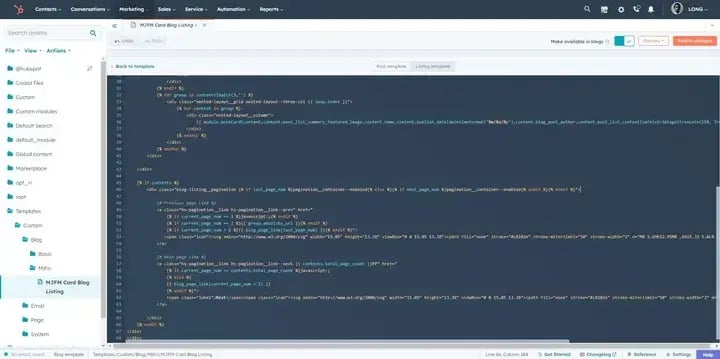
RevX approached this as a code investigation first — going directly into the HubSpot template to understand exactly what was causing the errors before attempting any fixes. The sequence mattered: diagnosing the root cause properly was the prerequisite for fixing it correctly.
RevX accessed the code of Long's HubSpot blog template and worked through it systematically to identify the specific lines responsible for the 404 errors. Rather than applying surface-level workarounds, the investigation went to the source — understanding precisely what the faulty code was doing and why it was generating errors before touching anything. That diagnostic discipline ensured the fix would address the actual problem, not just its symptoms.
Once the root cause was identified, RevX corrected the faulty code directly within the template. After the fix was applied, rigorous testing was conducted to validate that the 404 errors had been eliminated and that no further issues had been introduced in the process. The testing phase wasn't perfunctory — it was designed to confirm that the template would perform correctly under the conditions that had previously caused it to fail.
The impact
Two problems that had been quietly degrading Long's blog performance were resolved — the technical errors that created dead ends for visitors and search engines, and the tagging issues that had been limiting the content's discoverability.
With the faulty code corrected and tested, Long's HubSpot blog template was running cleanly for the first time. Visitors could navigate to blog content without encountering dead ends. Search engine crawlers could access and index posts without hitting error signals. The quiet damage that 404 errors inflict on site health — cumulatively, over time — stopped accumulating, and the template began working the way it had always been intended to.
The resolution of the tagging and categorization issues meant that Long's blog content was now correctly organized and readable by search engines. Posts could be properly categorized by topic, thematic signals could be read by crawlers, and the SEO value of the content the team had invested in creating was no longer being quietly undermined by structural issues in how that content was tagged. The blog's discoverability improved as a direct consequence.
Mockup