
 Salesforce
 HubSpot
 Claude
.png?width=58&height=58&name=Frame%202087327944%20(1).png) GA4
GA4
.png?width=58&height=58&name=Frame%202087327944%20(2).png) Marketo
Marketo
.png?width=58&height=58&name=Frame%202087327944%20(3).png) Audit Fox
Audit Fox
 Services
How Herewith built audience- and language-specific landing pages to reach caregivers and families
Herewith offers healthcare solutions for older adults, their families, and in-home care professionals.
Healthcare
United States
The challenge
Herewith's landing page problems were structural. A single undifferentiated page experience was being asked to serve audiences with fundamentally different needs — and doing it in only one language, at a pace that wasn't keeping up with campaign timelines.

The existing landing pages hadn't been built for speed or scalability. Getting a new page live required more time than the campaign cadence could comfortably accommodate, which meant opportunities to reach leads while their interest was still high were being lost to delays. In a marketplace where caregivers and families are often making time-sensitive decisions, slow launches aren't just operational inconveniences — they're missed conversions.
A caregiver visiting Herewith's landing page wants to understand job opportunities, placement support, and what the platform does for them as a working professional. A family member wants reassurance, quality signals, and clarity on how to find the right person to care for their loved one. A landing page that tries to speak to both simultaneously ends up speaking clearly to neither. Without audience-segmented pages, Herewith was presenting every visitor with a compromise that served no one particularly well.
Our solution
RevX built a segmented landing page architecture in HubSpot that addressed both the audience differentiation and the language requirements simultaneously — and put in place the workflow and advertiser integration infrastructure to drive traffic and track leads from launch.
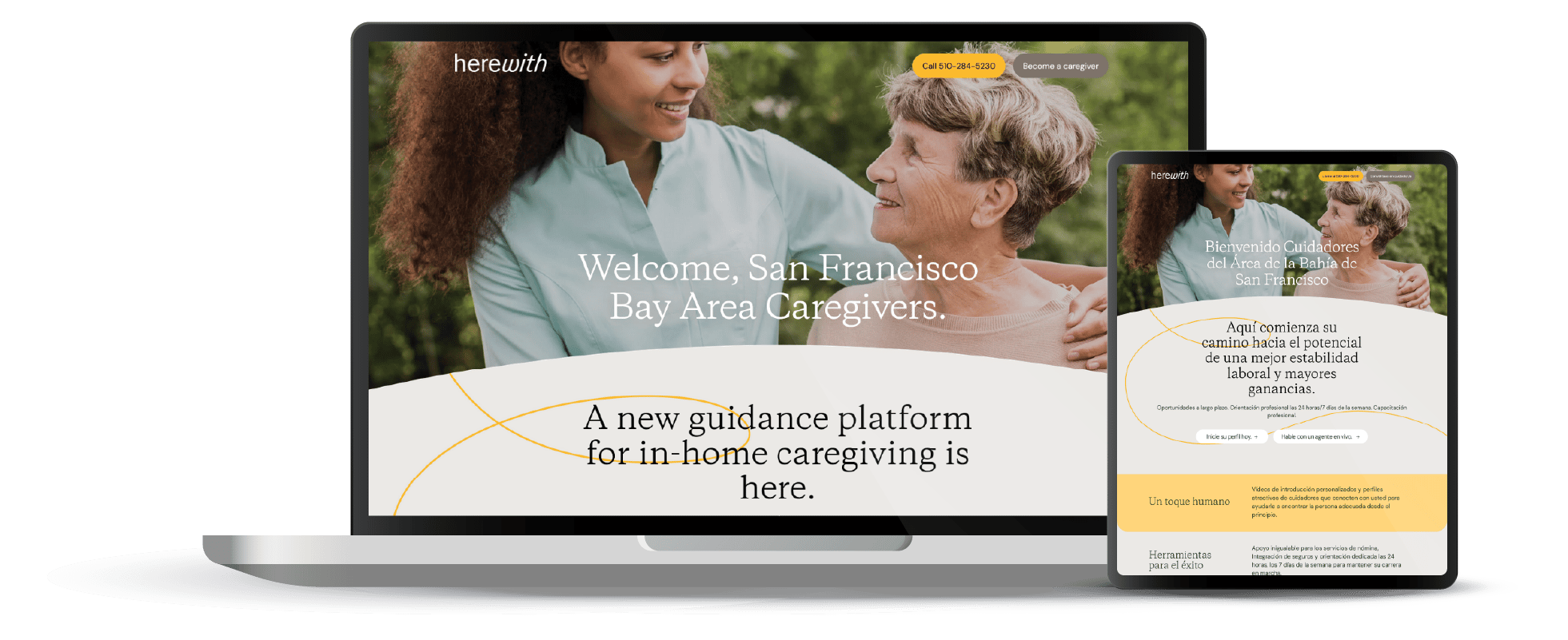
RevX created distinct landing pages for each audience type — caregivers and families — and built each in both English and Spanish, producing four core page variants in total. Each page was optimized for the specific motivations and language of its intended audience, ensuring that the message a caregiver received was relevant to their context and the message a family member received was relevant to theirs. All pages were delivered on schedule, ending the launch delays that had been costing Herewith campaign momentum.
RevX integrated with Herewith's advertising partners to drive initial traffic to the new landing pages, getting the campaign infrastructure in place and running from day one. A lead alert workflow was built to identify each incoming lead based on which page they had originated from — automatically tagging whether they were a caregiver or a family member, and in which language they had engaged. That routing logic gave the team the ability to follow up with context rather than treating every lead as an undifferentiated enquiry.
The impact
The segmented landing page architecture gave Herewith the ability to engage each audience on their own terms — with faster launches, better lead quality, and a more personal experience for Spanish-speaking visitors.
Optimized, purpose-built landing pages replaced the unoptimized setup that had been causing delays. Campaigns could go live when they needed to, rather than when the infrastructure was finally ready. For an audience that includes caregivers and families in active, time-sensitive decision-making processes, that speed improvement had a direct bearing on conversion — reaching people at the moment their interest was highest rather than after it had begun to cool.
With caregivers and families landing on pages built specifically for them, the quality of the leads each page generated improved meaningfully. Visitors who felt the page was speaking to their situation were more likely to engage, more likely to complete a form, and more likely to be the kind of lead worth following up. The lead alert workflow reinforced this by ensuring the team always knew where a lead had come from and what that implied about their needs.
Mockup